
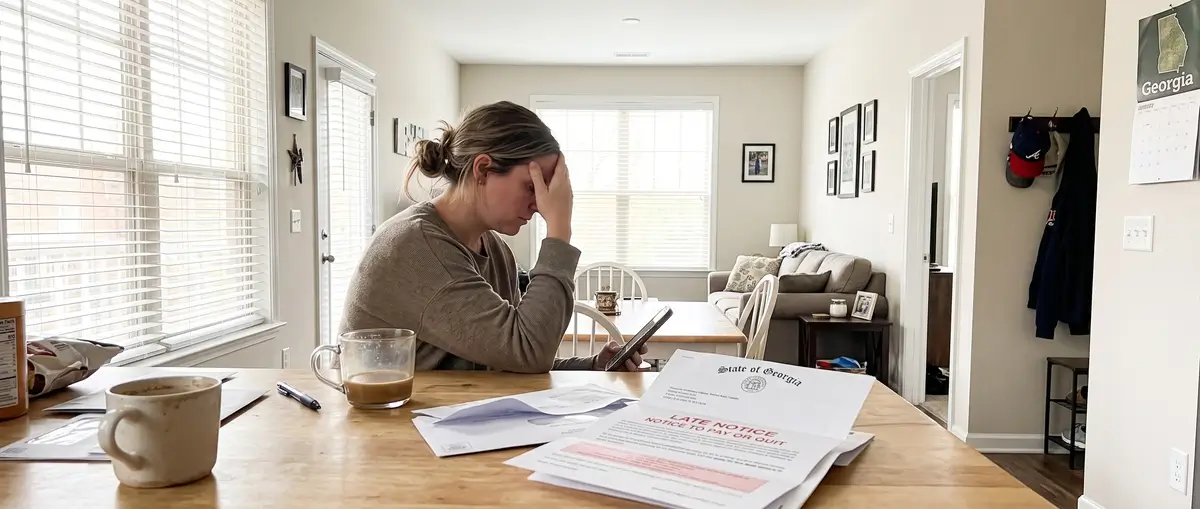
The 1st of the month comes and goes, and the payment you count on never arrives. Your tenant stops answering texts, and you start weighing your options. Consistent rent collection prevents many of these moments. When one slips through, a properly served Georgia late rent notice now decides whether an eviction case can begin.
For Atlanta landlords, the stakes also reach past the courtroom. Georgia eviction records shape tenant screening long after a case closes, and a new sealing law arrives in 2027. Here's how each step works, from the first notice to the record that follows.
Key Takeaways
- For leases signed or renewed since July 1, 2024, Georgia requires a 3-business-day notice to pay or vacate before filing for nonpayment.
- Clear lease terms on due dates, late fees, and notice delivery strengthen every later step.
- Only court officers can remove a tenant, and only after a writ of possession takes effect.
- Starting January 1, 2027, Georgia courts can seal certain eviction records.
When Rent Becomes Late Under Georgia Law
In Georgia, rent is late the day after the due date in your lease unless the lease includes a grace period. The state sets no default grace period for residential rent. Late fees follow the same logic and are generally enforceable only when the lease states the amount and timing.
Leases Covered by the Safe at Home Act
The Safe at Home Act's notice rules apply to residential leases entered into or renewed on or after July 1, 2024. If you manage tenants on older agreements, confirm which rules apply at each renewal.
The 3-Day Notice to Vacate or Pay in Georgia
A Georgia 3-day notice to vacate or pay is a written notice giving a tenant 3 business days to pay all past-due amounts or move out. Under O.C.G.A. § 44-7-50, you must serve it and wait out the full period before filing for nonpayment. Filing early can give the tenant grounds to have the case dismissed.
Counting Business Days Correctly
Saturdays, Sundays, and Georgia legal holidays don't count toward the 3 days. A notice posted on a Thursday gives the tenant Friday, Monday, and Tuesday. The earliest filing date would typically be Wednesday, assuming no legal holiday falls in that window.
What the Notice Must Include
The notice must cover all past-due rent, late fees, utilities, and other charges owed. Itemizing each amount helps protect you if the tenant later disputes the balance in court.
How to Serve a Late Rent Notice in Georgia
Georgia law requires you to post the notice in a sealed envelope in a visible spot on the door. You must also deliver it through any additional method your lease specifies.
Situations Where the Notice Does Not Apply
The 3-business-day requirement doesn't apply to evictions for criminal activity, filings by a public housing authority, or cases based on anything other than nonpayment.
Georgia's Dispossessory Process After the Notice
Georgia's dispossessory process is the court procedure landlords use to regain possession of a rental. It begins once the notice period expires without payment. Many owners weigh the professional property management results they could expect before taking on a case alone.
The Georgia Eviction Process Timeline
Most nonpayment cases follow this order:
- Serve the 3-business-day notice to vacate or pay.
- File a dispossessory affidavit, which asks the court for possession and unpaid rent.
- A court officer serves the tenant with the summons.
- The tenant has 7 days to file an answer.
- The court holds a hearing or enters a default judgment.
- The court issues a writ of possession if you win.
Service and the Tenant's 7-Day Answer Window
If the summons is served by tack and mail, the court can't award a money judgment unless the tenant files an answer. A tenant who misses the 7-day answer window faces a default judgment.
The Tender Defense
The tender defense lets a tenant end a nonpayment case by paying all rent owed plus court costs within 7 days of service. You only have to accept this payment once in any 12-month period.
Writ of Possession Timing
A writ of possession is the court order that authorizes the tenant's removal. After a hearing, the writ takes effect 7 days after judgment. When a tenant never answers, the court can issue the writ immediately. Either way, only court officers can carry it out.
Late Rent and Eviction Filings Across Metro Atlanta
Atlanta landlords follow the same statewide eviction rules as every Georgia owner, but filing logistics vary by county.
Filing in the Right County Magistrate Court
The rental address decides where you file. The City of Atlanta crosses Fulton and DeKalb counties. Nearby, Marietta and Smyrna fall under Cobb County, Lawrenceville falls under Gwinnett, and Alpharetta and Roswell fall under Fulton. Filing in the wrong county can mean starting over.
Fulton County Magistrate Court Deadlines
Each county sets its own forms and fees. In the Fulton County Magistrate Court, an eviction may be requested on the 8th day if a served tenant doesn't answer. Once a writ is issued, the eviction must be requested within 30 days, or you'll need to file a new dispossessory warrant.
Local Rental Assistance That Can Resolve a Balance
Tenants in Fulton County can contact the Fulton County Housing Assistance Center for help. When assistance resolves a balance during the notice window, you may avoid a filing altogether.
How Georgia Eviction Records Follow Tenants
Georgia eviction records are public court records created when a landlord files a dispossessory affidavit. They can appear on tenant screening reports, even in cases the landlord didn't win.
Eviction Record Sealing Arrives in 2027
Starting January 1, 2027, eviction record sealing in Georgia becomes possible under Senate Bill 406, which adds a new subsection to O.C.G.A. § 44-7-50. After a motion and hearing, a court may make dispossessory records unavailable to the public in 3 situations:
- The tenant won the case.
- The tenant paid the judgment in full, including interest and costs.
- 7 years have passed since a dismissal or a paid judgment.
What Sealing Means for Owners and Screening
Since qualifying cases usually involve a tenant win or a paid judgment, sealing rarely limits what you can recover. Applicant reports may show fewer past filings, though. That makes verifying rental history with prior landlords more important.
Common Mistakes That Weaken a Late Rent Case
Even a valid Georgia late rent case can fall apart over 3 avoidable mistakes:
- Self-help eviction: Changing locks or shutting off power, water, heat, or cooling before judgment is illegal in Georgia.
- Retaliatory timing: Filing soon after a tenant requests repairs or contacts a government agency can invite a retaliation defense.
- Weak documentation: Missing rent ledgers, undated notices, or no proof of posting make your case harder to prove.
FAQs
1. Can I send a late rent notice by text or email in Georgia?
The notice must be posted in a sealed envelope on the door. If your lease names text or email as delivery methods, send it those ways too.
2. What happens if my tenant pays after I file for eviction?
Paying all rent owed plus court costs within 7 days of service ends a nonpayment case under the tender defense. You must accept that payment only once in any 12-month period.
3. Where do I file an eviction for a rental inside Atlanta city limits?
File in the magistrate court of the county where the property sits, either Fulton or DeKalb within city limits. Confirming the county first prevents a costly restart.
4. Will sealed eviction records show up when I screen applicants?
Sealed dispossessory records become unavailable to the public, so they may not appear on screening reports. Contacting prior landlords directly helps fill that gap.
Protecting Your Atlanta Rental Starts with the First Late Notice
Most eviction cases are decided long before a hearing. They turn on whether the notice was counted correctly, posted properly, and backed by clean records. As sealed records reshape screening in 2027, owners whose paperwork holds up from day 1 will stay protected.
At DK Rentals, we prepare, sign, and serve every required notice on your behalf. We handle the process from start to finish, including court action across metro Atlanta when needed. If a missed payment is already on your desk, let our full-service eviction support take it from here.